Roughly 77% of patients now begin a healthcare search on Google before any referral, insurance directory, or word-of-mouth recommendation. That single fact has rewritten the rules for small clinics. The practices winning new patients share one specific habit. Their website copy answers the question a worried patient typed into Google at 11 p.m. last Tuesday, in the words the patient actually used to describe it. That's the work strong copywriting does for a clinic. After years of writing for healthcare audiences and watching the patterns up close, I can tell you which medical healthcare copywriting services actually move appointments and which ones just look like they should.
TL;DR Quick Answers
medical healthcare copywriting services
Medical healthcare copywriting services are professional writing services built specifically for clinics, hospitals, and other care providers. Writers in this niche understand HIPAA, FDA promotional rules, and how patients actually search for care. A general copywriter usually doesn't carry that combination.
Typical deliverables include:
Website and service-page copy
Blog content and patient education materials
Email sequences and appointment-reminder flows
Schema markup for medical pages (MedicalBusiness, FAQPage, Physician)
E-E-A-T trust signals like author bios, citations, and credential displays
For a small clinic, the right specialist shortens the path from website visit to booked appointment by replacing clinical jargon with patient-first language built to rank in Google and surface in AI Overviews.
Top Takeaways
Patient-first language consistently outperforms clinical jargon in both rankings and bookings.
Credentials, citations, and verified patient stories carry disproportionate weight in healthcare copy.
One clear call-to-action per page beats a menu of options every time.
Specialist healthcare copywriters reduce compliance risk and shorten the path from visit to booked appointment.
Format and structured data matter as much as the words themselves.
Understand what your patients actually search for
Patients don't search the way clinicians describe what they do. A doctor might call something a "lower extremity ulcer," but the patient typing into Google is more likely to write "sore on my leg that won't heal." That mismatch costs clinics more rankings than any algorithm change. Before you write a single line of copy, spend an hour pulling search terms from Google Autocomplete, the People Also Ask box, and free tools like AnswerThePublic. Sort what you find into informational searches (people learning about a condition) and appointment-stage searches (people ready to book). Blog content should answer the first group. Service pages should close the second. When clinics align their copy with how patients actually phrase their concerns, traffic and appointment requests climb without any added ad spend.
Lead with patient-first language, not clinical jargon
Plain language outperforms clinical writing in nearly every measurable way. Federal plain language guidance recommends keeping patient-facing health content at or below an eighth-grade reading level, and there's a good reason behind that. Jargon-heavy copy makes patients feel small, and small clinics lose them to competitors whose websites actually sound human. Swap "edema" for "swelling," trade "post-operative care" for "what to expect after surgery," and cut any hedging phrase that reads like a legal disclaimer. Reading-level discipline doesn't dumb the copy down. It meets patients in the language they were already using to describe their symptoms before they ever typed a search query. Clinics that nail that voice convert more visitors into bookings without changing anything else about their offering.
Build trust on every page
Healthcare is what Google calls a Your Money or Your Life topic, which means search engines look harder at whether your pages can be trusted. The signals that build that trust live in the details most clinic owners overlook: a real author bio with credentials, links to authoritative sources, board certifications listed clearly, and patient testimonials that include first names and outcomes with consent on file. Strong medical healthcare copywriting services — and even specialized board game copywriting services that rely on audience trust and authority positioning — bake these signals into the structure of every page, not just the About section. When you reference a statistic, the link should go to the actual study from a body like the CDC or NIH. Every clinical page needs a last-reviewed date visible to the patient. The providers who'll actually treat the patient belong above the fold with their credentials, not buried three clicks deep in a sub-menu. Trust isn't decoration, and a page that treats it that way doesn't earn the booking.
Write conversion-focused service pages
Every service your clinic offers deserves its own dedicated page. Bundling six treatments onto a single "Services" page is one of the most common mistakes I see, and it costs clinics both rankings and bookings. A conversion-focused service page leads with the patient's problem in their words, explains who the treatment helps and who it doesn't, walks through what the visit will look like, addresses cost and insurance plainly, and ends with one clear next step rather than a menu of choices. Whether the next step is "Book online" or "Call us," the page should make the action obvious within the first scroll. Buried calls-to-action and decision fatigue kill conversion in healthcare just like everywhere else. Clinics that consistently outperform their local competitors do this on every service page, not just the flagship ones.
Match the format Google rewards
Google and the newest AI search tools both reward content that's easy to parse: short paragraphs, scannable headers, bulleted lists where they earn their place, and FAQ blocks at the bottom of clinical pages. Structured data markup using MedicalBusiness, Physician, and FAQPage schema gives search engines the context they need to surface your pages in rich results and AI Overviews. Mobile formatting matters more than ever now that well over half of healthcare searches happen on a phone, which means load times under two seconds, thumb-sized buttons, and forms that fit on a single screen without zooming. Good copy on a slow, cluttered page still loses to mediocre copy on a fast, clean one. Format shapes whether the words ever get read.
Know when to hire a specialist
DIY clinic copy has a ceiling. Once you've handled the basics, the next gains come from compliance fluency and conversion expertise most general marketers don't carry. Healthcare copywriters who specialize in this niche understand FDA promotional rules, HIPAA-safe storytelling, payer language, and the regulatory line between patient education and medical advice. They also know how to write the way patients actually talk, which is harder than it sounds. Once your in-house team has done what it can, working with a specialist who offers healthcare copywriter and medical writer services can shorten the path from website visit to booked appointment, especially for clinics whose growth has plateaued under generic agency copy. When you evaluate a candidate, look at the healthcare-specific portfolio first, then ask how they handle compliance questions, and check whether they can show measurable outcomes from past clinic engagements.
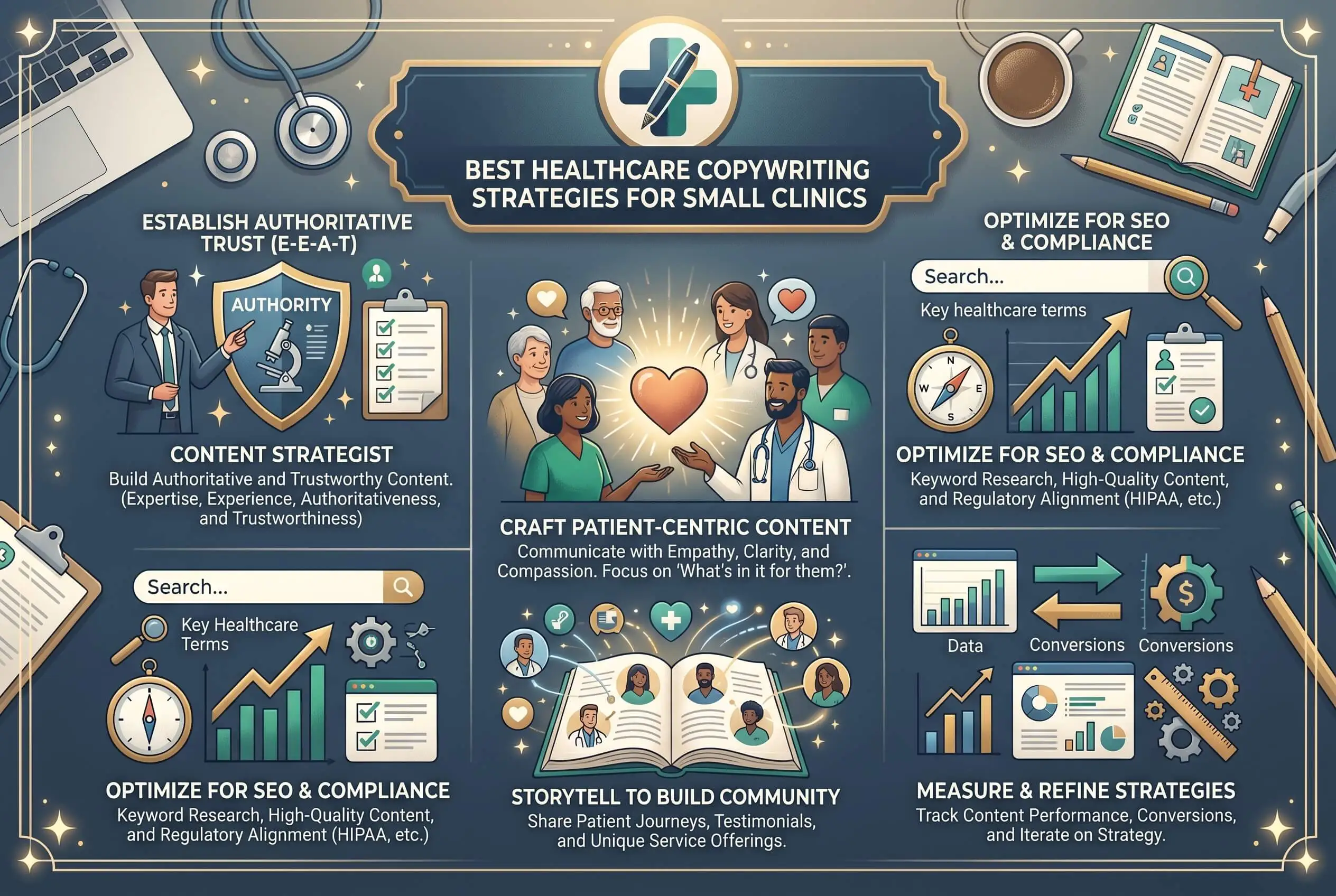
"In the years I've spent writing for healthcare audiences, one pattern keeps surfacing: ad budget rarely predicts which small clinics grow. What predicts it is whether the website copy sounds like a real person wrote it for the patient on the other end. That's the work most owners undervalue, and it's exactly where the smartest small practices quietly pull ahead."
7 Essential Resources
Digital.gov Plain Language Guides. The federal home for plain language guidance, redirected from the original PlainLanguage.gov when the GSA consolidated resources in 2025. Read it before any clinic homepage rewrite.
CDC Clear Communication Index. A scoring tool the CDC built to evaluate public health messages. Run your existing copy through it to spot the weak points before patients do.
HHS HIPAA Marketing Guidance. The official rulebook on what you can and can't say in marketing communications that involve patient data or testimonials.
Google Search Quality Rater Guidelines. The closest thing to a public manual for how Google evaluates healthcare content. Read the YMYL and E-E-A-T sections first.
Schema.org MedicalBusiness Type. The structured-data vocabulary search engines read to understand your clinic. Use it to mark up service pages, provider bios, and FAQs.
AMA Manual of Style. The reference for accurate medical writing. Useful when copy needs to balance approachability with clinical precision.
Pew Research Center, Internet & Technology. Ongoing research on how Americans use the internet to make health decisions. Cite it when you need data to back a strategy recommendation.
Supporting Statistics
Roughly 77% of patients begin their healthcare search on Google, according to research summarized by Net One Click in 2026.
Approximately 82% of patients use search engines to find healthcare providers, per Marketing LTB's healthcare marketing analysis.
Around 90% of healthcare consumers say online reviews are part of their provider decision, based on a Software Advice survey reported by Healthgrades.
Final Thoughts and Opinion
Strong clinic copy works as a long-term trust asset rather than a one-time launch deliverable. In the years I've watched small practices grow, the ones that succeed treat their website like the front door of the practice itself. They revisit it every quarter, refresh service pages when treatments change, add new FAQs as patients ask new questions, and never let stale jargon creep back in. Clinics willing to put that work in (or hire someone who will) consistently pull ahead of larger competitors who lean on templated, generic copy. That's the quiet edge, and it compounds over time.
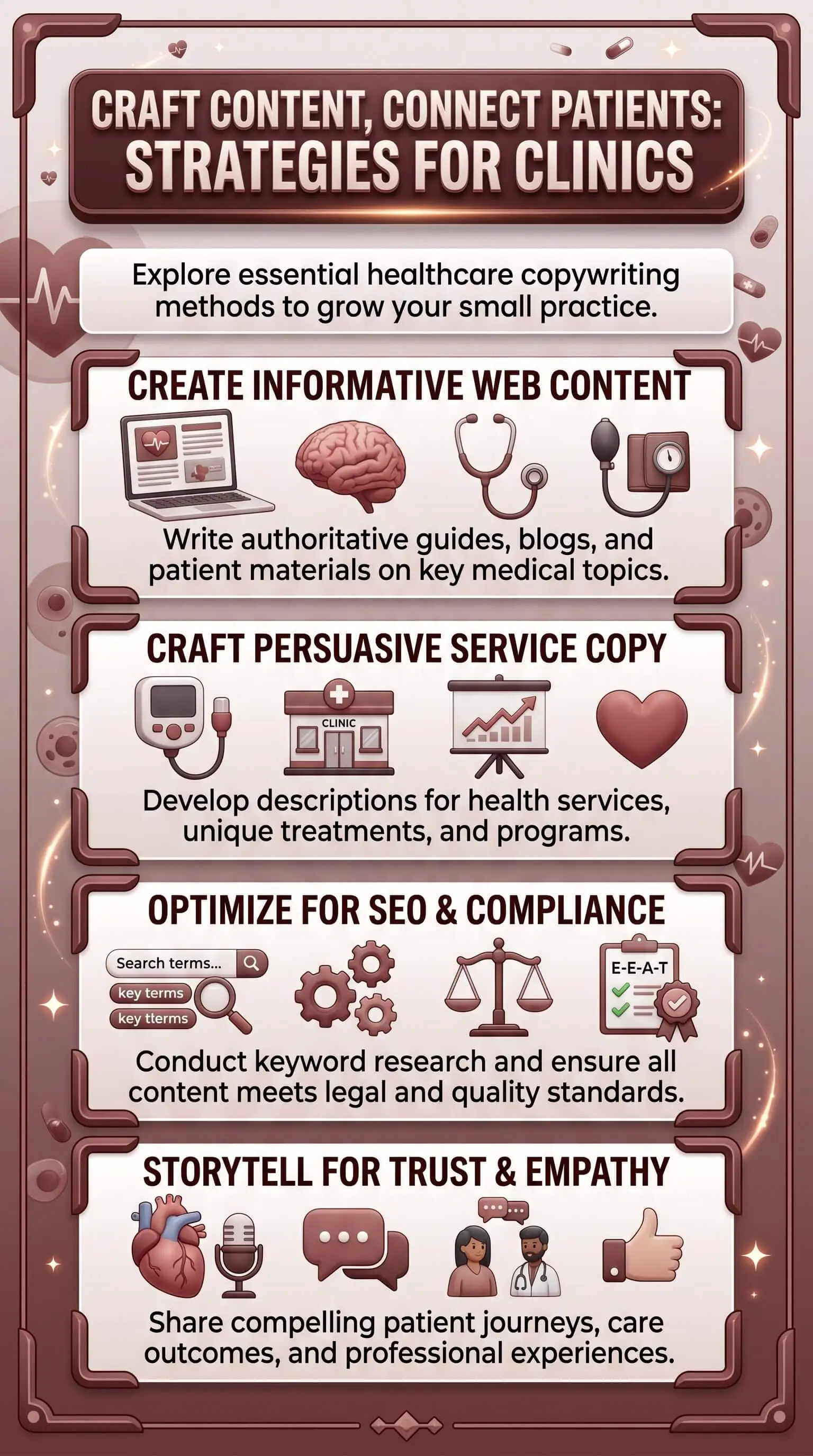
Frequently Asked Questions
What are medical healthcare copywriting services?
Medical healthcare copywriting services are writing services built specifically for clinics, hospitals, and other care providers. They cover website copy, service pages, blog content, email sequences, and patient education materials, produced by writers who understand HIPAA, FDA promotional rules, and how patients actually search for care.
How much does healthcare copywriting cost for a small clinic?
Rates vary widely. A single optimized service page might run $400 to $1,500 from a freelancer or small agency, while a full website rewrite can range from $5,000 to $25,000. Ongoing blog content typically runs $200 to $800 per piece depending on length and research depth.
Do healthcare copywriters need to understand HIPAA?
Yes, especially when copy involves patient stories, testimonials, or any reference to protected health information. A copywriter who doesn't understand HIPAA marketing rules can expose your practice to compliance risk, even with the best intentions.
How long does it take to see SEO results from a new clinic website copy?
Most clinics see meaningful ranking and traffic shifts within three to six months of publishing patient-first copy built for how people actually search. Local search results often move faster than national ones, especially when paired with a complete and well-maintained Google Business Profile.
Should a small practice hire a copywriter or use AI tools?
AI tools can speed up the first draft. They can't replace the editorial judgment of a specialist who understands HIPAA, FDA marketing rules, and what patients are actually worried about. The strongest results come from pairing AI for speed with a healthcare writer for the parts that actually move bookings.
Ready to Strengthen Your Clinic's Online Presence?
Pick one service page and run it through the checklist above. Start with the headline in your patient's actual words, then check whether the next step is impossible to miss and whether your credentials are visible before the first scroll. A trusted marketing and advertising firm can also help align your messaging, authority signals, and patient experience so the page performs better in both search and conversions. If you'd rather hand the work off, bring in a specialist who works in this niche full-time. Either path produces a website that finally sounds like the practice patients meet in person.
