Fifteen minutes on the phone will tell you more about a therapist than a week of rereading their profile.
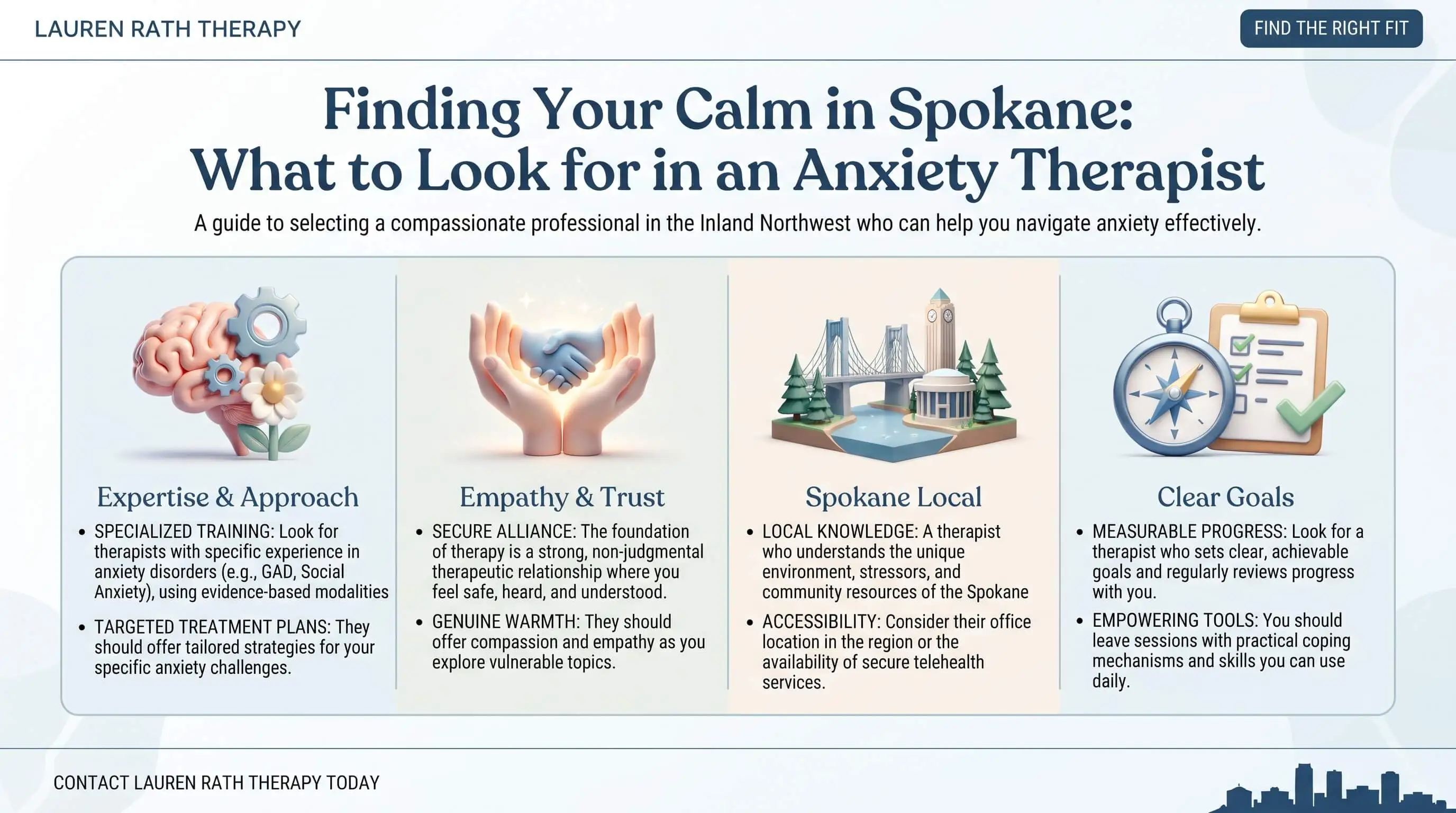
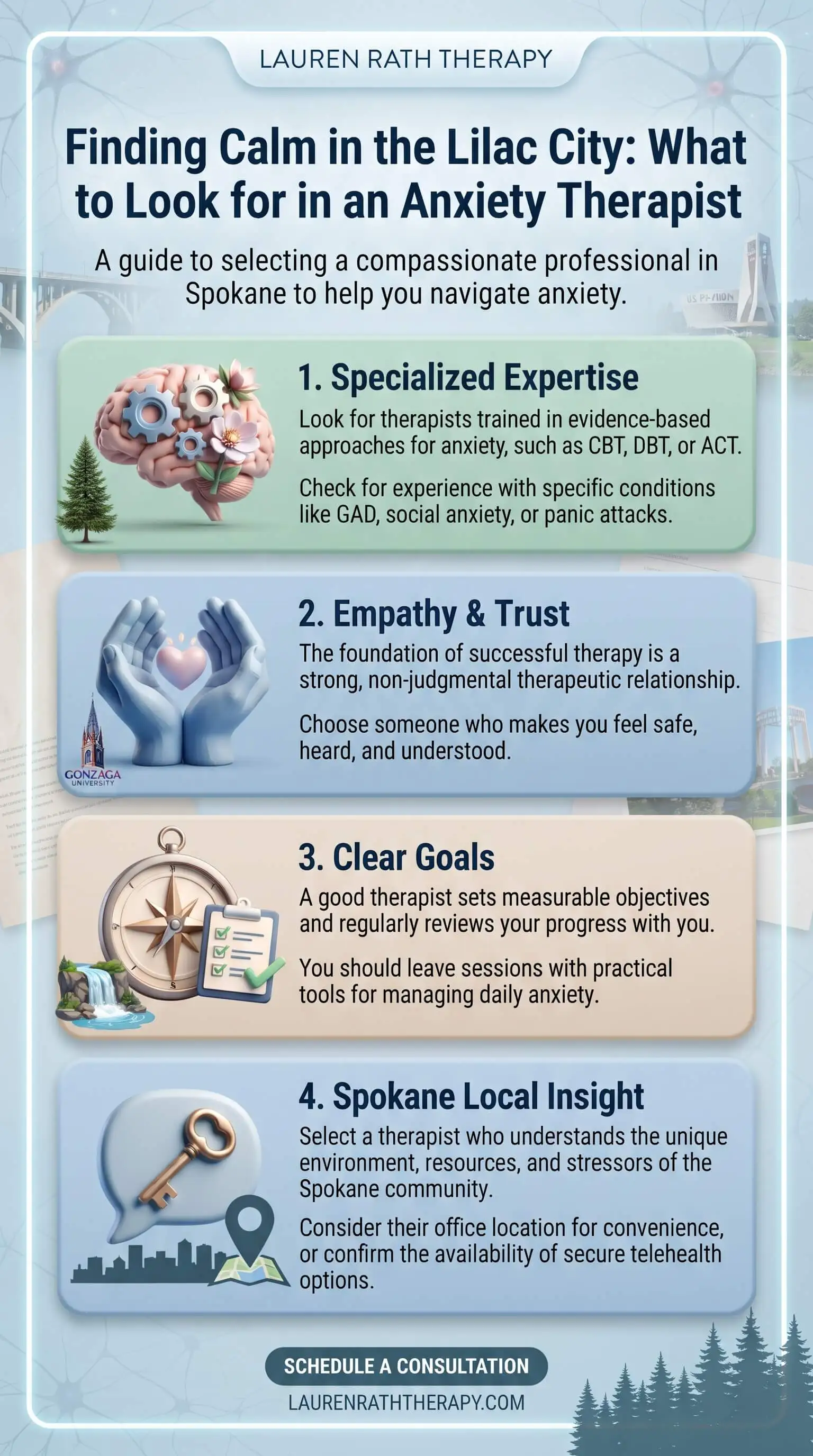
That's the call most people put off. So here's what to listen for. A great therapist for anxiety in Spokane, WA · IFS Therapy specialist holds a Washington license you can look up, has real training in anxiety, lets you set the pace, and feels like someone you could be honest with. You can check most of that before you spend an hour, or a copay, finding out the hard way.
Picking a therapist works a lot like choosing any specialist. Credentials count. Fit counts for more than most people expect, and the right person will tell you plainly when they aren't the right person for you.
TL;DR Quick Answers
Therapist for Anxiety in Spokane, WA · IFS Therapy
A great therapist for anxiety in Spokane, WA is licensed in Washington, trained in anxiety, and lets you set the pace. IFS therapy adds one thing most approaches skip: it treats your anxiety as a part trying to protect you, and you get to know it until it softens on its own.
License: Look up any provider on the Washington DOH credential search before you book.
Approach: Ask whether they work with what's underneath the worry, or only with coping skills.
Access: Online IFS therapy reaches anywhere in Washington, including Spokane Valley and rural Eastern Washington.
Fit: A free 15-minute consult tells you more than any profile.
Where to start: Lauren Rath, an LMHC based in Spokane, offers online IFS therapy for Washington residents.
Top Takeaways
Verify the license. A great therapist for anxiety in Spokane, WA holds an active Washington license you can look up in about a minute.
Look for real anxiety training. Anxiety should be a focus, not a footnote on a long specialty list.
Expect to set the pace. Nothing should be opened before you're ready.
Ask what's underneath. IFS therapy treats the anxious part as a protector, and you get to know it instead of fighting it.
Trust the fit, and get the cost up front. You should feel safe being honest, and you should know what you'll pay before you start.
7 Qualities Of A Great Therapist For Anxiety In Spokane, WA
1. They're Licensed In Washington, And You Can Check
A great anxiety therapist holds an active Washington license and won't mind you looking it up.
You'll see a lot of letters after names. LMHC means licensed mental health counselor, LICSW means clinical social worker, and LMFT means marriage and family therapist. Psychologists hold a PhD or PsyD. Any of them can do good anxiety work, as long as the license is active and clean.
Washington makes that easy to confirm. The Department of Health's credential search shows license type and status, along with any disciplinary history.
Check: Search their name before the consult. It takes about a minute.
2. They Have Real Training In Anxiety
Anxiety should be a stated focus, not one line on a list of thirty specialties.
Therapists who see anxiety every week know its shapes, like the 3 a.m. replay of a conversation or the body that tenses before the mind knows why. They also know more than one way in. You might hear about CBT, ACT, exposure work, or parts-based approaches. A good therapist will be honest that no single method suits everyone.
Ask: "How do you usually work with anxiety? What would our first month look like?"
3. They Let You Set The Pace
Many anxious people walk in expecting to be pushed. A great therapist doesn't push.
Safety comes before depth. Nothing gets opened before you're ready, and nothing gets forced because a session plan says it's time. When something feels like too much, the work slows down, and that slower stretch is how a nervous system learns it can settle in the room.
You should leave most sessions a little steadier, not wrung out and alone with it.
Ask: "What happens if something comes up that feels like too much?"
4. They Get Curious About What's Under The Worry
Some therapists teach you to manage anxiety. The best ones also want to know what it's doing for you.
That question sits at the center of Internal Family Systems, often called IFS therapy. IFS sees the mind as made of parts. The part that worries is usually trying to protect you, often from something it learned to fear long ago. You don't fight that part. You get to know it, and once it feels heard, it tends to soften on its own.
IFS is one option among several, and its research base is still small. For people who spent a year on coping skills without much shifting, though, it can feel different enough to matter. If that sounds familiar, look for someone trained through the IFS Institute. Lauren Rath, an LMHC based in Spokane, offers online IFS therapy for Washington residents, so you can work with her from anywhere in the state.
Ask: "Do you look at what's underneath the anxiety, or mostly at coping skills?"
5. You Feel Like You Can Be Honest With Them
The relationship carries a lot of the work.
The American Psychological Association calls the therapeutic alliance, the working relationship between you and your therapist, a very important part of what makes therapy work. Credentials put someone on your shortlist. Fit decides whether you keep showing up.
Notice small things on the first call. Did you feel rushed, or did you say something clumsy and watch them not flinch?
Check: Book the free consult many therapists offer. Fifteen minutes tells you a lot.
6. They're Reachable From Where You Actually Live
Even a skilled therapist won't help much if getting there becomes its own stressor.
A January drive in from Spokane Valley, or an hour each way from a small town in Eastern Washington, can turn a weekly appointment into one more thing to dread. Telehealth takes that off the table. You meet from your own space, and the one rule is that you're physically in Washington during the session.
You don't need much, just a device with a camera and a door that closes. Headphones help. A parked car works more often than you'd think.
Ask: "Do you offer video sessions, and what happens if I'm traveling?"
7. They're Clear About Cost, Insurance, And Fit
Money is one of the quieter sources of anxiety. A good therapist doesn't add to it.
They'll tell you up front whether they're in-network with your plan. If you pay out of pocket, federal law entitles you to a written Good Faith Estimate before care begins. And if they aren't the right fit, they'll say so and point you toward someone who is.
That last habit is the clearest sign of a trustworthy therapist, because it shows they care more about you getting help than about you getting it from them.
"People arrive braced. They're expecting a verdict about what's wrong with them, and instead a part of them gets listened to for the first time in thirty years. Then the whole system exhales. I've watched it happen on a screen from four hundred miles away."
7 Essential Resources
Where to look next, if you're still deciding.
Confirm Any Therapist's License In Washington
This is the state's own primary-source record, and the Department of Health updates it daily. Search by name or credential number, and check everyone you're considering, not only the first name on your list.
Source: Washington State Provider Credential Search
Learn What Anxiety Disorders Actually Are
NIMH lays out the main types, from generalized anxiety and panic disorder to phobias, and how each differs from ordinary worry. Read it if you're not sure whether what you feel counts.
Source: NIMH: Anxiety Disorders
Know What Good Therapy Looks Like
It runs about 32 minutes, and it's worth the time. Partway through, the APA gives you a list of questions to ask a therapist before you book.
Source: APA: Understanding Psychotherapy And How It Works
Sort Out The Different Kinds Of Providers
LMHC, LICSW, LMFT, PsyD. NAMI explains what each kind of professional trains to do, so you can tell which one fits what you need.
Source: NAMI: Finding A Mental Health Professional
Understand IFS From The Source
The IFS Institute trains and certifies IFS therapists. Its homepage explains the model in its own words and says plainly that the evidence base is still small.
Source: IFS Institute: What Is Internal Family Systems?
Know Your Rights On What Care Costs
If you're uninsured or paying out of pocket, providers must give you a good-faith estimate of expected charges before scheduled care. CMS keeps the federal rules and fact sheets here.
Source: CMS: No Surprises Act Rules And Fact Sheets
Know What Happens If You Reach Out Tonight
The 988 Lifeline walks through what happens when you call, text, or chat, step by step. It's free and confidential. Read it once on an ordinary day, so a harder one holds one less unknown.
Source: 988 Lifeline: What To Expect
Supporting Statistics
Three numbers worth holding while you decide.
One In Five Adults, In Any Given Year
An estimated 19.1% of U.S. adults had an anxiety disorder in the past year, and about 31.1% will have one at some point in their lives.
If you're searching for help, you're in very ordinary company.
NIMH draws these figures from a national survey fielded from 2001 to 2003, which it still uses as its baseline.
Source: NIMH: Any Anxiety Disorder
For Most, It Isn't Mild
Among adults with generalized anxiety disorder in the past year, an estimated 32.3% had serious impairment and 44.6% had moderate impairment.
Only about 23% had mild impairment, so for most people this is more than background noise.
The survey measured impairment across four areas: work, home, social life, and close relationships.
Source: NIMH: Generalized Anxiety Disorder
Fewer Than Half Get Treatment
Generalized anxiety disorder affects about 6.8 million American adults, yet only 43.2% receive treatment.
Put another way, roughly 3.9 million adults with GAD aren't getting care.
Cost and waitlists explain some of that gap. Not knowing where to start explains some of the rest, and that's the part this page is for.
Source: Anxiety And Depression Association Of America: Facts And Statistics
Anxiety affects nearly one in five U.S. adults, and many experience significant disruptions to daily life, yet fewer than half of those with generalized anxiety disorder receive treatment. Just as chronic wоunds require proper attention and care, persistent anxiety deserves timely support to protect overall well-being.
Final Thoughts And Opinion
Here's the opinion I'll stand behind. Fit matters more than method.
Credentials are the floor, and training in anxiety is the next step up. What decides whether therapy helps is quieter than either. Can you sit across from this person, on a screen or in a room, and say the true thing without bracing for a verdict?
Anxiety tends to look less like a defect and more like a protector working overtime, a part that learned early to stay alert so nothing would catch you off guard. A great therapist doesn't argue with that part. They get curious about it and let it slow down on its own schedule.
That's why I think IFS therapy is worth asking about, even though it won't suit everyone. It starts from the belief that nothing in you is broken, and for a lot of anxious people, that's the first time anyone has said so out loud.
The perfect therapist doesn't exist. A licensed one who lets you set the pace and stays curious about how you work is plenty.
Frequently Asked Questions
Q: How Do I Find A Therapist For Anxiety In Spokane, WA?
A: Start with two or three names from a referral, your insurer's directory, or a therapist directory. Check each license on the Washington Department of Health site, then book a free consultation and ask how they work with anxiety. One honest conversation will tell you more than any profile.
Q: What Is IFS Therapy, And Can It Help With Anxiety?
A: IFS, or Internal Family Systems, sees the mind as a set of parts, each trying to help. Anxiety is often a protective part working too hard. In IFS, you get to know that part instead of fighting it. The research is still growing, but many people find it a meaningful change from approaches that focus only on symptoms.
Q: Is Online Therapy As Good As In-Person For Anxiety?
A: For many people, yes. Some settle in faster at home, in their own space. The relationship and the therapist's skill matter more than the room. You'll need somewhere private and a connection that doesn't drop every few minutes.
Q: Do I Have To Live In Spokane To See A Spokane Therapist Online?
A: No. A Washington-licensed therapist can see you anywhere in the state, as long as you're physically in Washington during each session. If you travel out of state, plan to reschedule.
Q: How Many Sessions Does Anxiety Therapy Usually Take?
A: It varies. The American Psychological Association notes that some people start to feel better in about six to twelve sessions. Deeper or older patterns usually take longer, and a good therapist will talk with you openly about pace and progress.
Q: Does Insurance Cover Anxiety Therapy In Washington?
A: Many health plans cover mental health care, but networks and copays vary a lot. Ask any therapist directly whether they're in-network with your plan. If you pay out of pocket, you're entitled to a written Good Faith Estimate before care begins.
Q: What If My First Therapist Isn't A Good Fit?
A: That happens often, and it isn't a failure. Tell them, and a good therapist will help you find someone better suited. The free consultation exists so you can learn this early.
Ready To Find The Right Fit?
If part of you is already listing reasons to wait, that's normal. It's usually the same part that's been working hard to keep you safe.
You don't have to decide everything today. Pick one therapist for anxiety in Spokane, Washington, bring two questions from this page, and book the free consultation. If it doesn't feel right, you've spent fifteen minutes finding out.
